
 By Elina
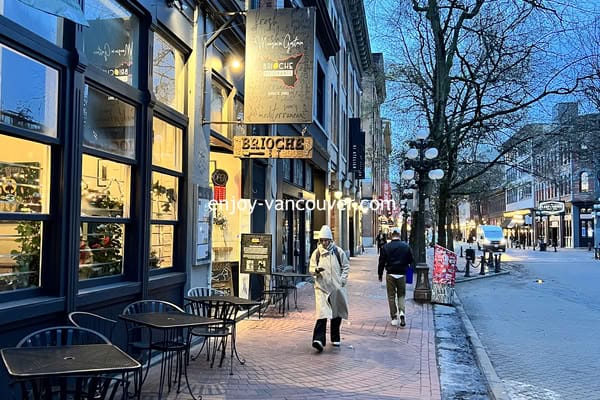
Should you bring cash to Vancouver, rely on your credit card, or exchange money after arriving in Canada? Choosing the right payment methods can help you avoid unnecessary fees and manage your travel budget more effectively.
Vancouver is a card-friendly destination where major credit cards, debit cards, and mobile payments are widely accepted. However, carrying a small amount of Canadian cash is still useful for unexpected situations, independent businesses, and certain everyday expenses.
This Vancouver travel money guide explains how Canadian currency works, where to exchange money, how to use ATMs, whether U.S. dollars are accepted, and what international visitors should know about taxes, tipping, and foreign transaction fees.
Vancouver Travel Money: Quick Guide for Tourists
| Money and Payments | What Visitors Should Know |
|---|---|
| Official currency | Canadian dollar (CAD) |
| Currency symbol | $ or C$ |
| Recommended payment method | Credit or debit card with low foreign transaction costs |
| Suggested backup cash | C$50–C$100 per adult for a typical city trip |
| Credit cards | Visa and Mastercard are widely accepted; American Express acceptance varies |
| Mobile payments | Widely available at compatible terminals |
| U.S. dollars | Accepted by some businesses, but not universally |
| Currency exchange | Banks, currency exchange offices and airport services |
| ATMs | Widely available; fees depend on the operator and card issuer |
| Federal sales tax | 5% GST on most taxable purchases |
| General provincial sales tax | 7% PST, with exemptions and different rates for certain purchases |
| Restaurant tipping | Usually around 15–18% for table service; discretionary unless a mandatory charge applies |
| Border currency declaration | C$10,000 or more in combined currency and monetary instruments |
All dollar amounts in this guide are in Canadian dollars unless otherwise stated. Suggested cash amounts are practical recommendations, not official requirements.
What Currency Is Used in Vancouver?
Vancouver uses the Canadian dollar, internationally identified by the currency code CAD. It is the official currency throughout Canada, including British Columbia.
Visitors from the United States should remember that Canadian and U.S. prices may use the same dollar symbol, even though the currencies have different values.
Unless otherwise indicated, prices displayed in Vancouver shops, restaurants, hotels, and attractions are in Canadian dollars.
Canadian Banknotes and Coins
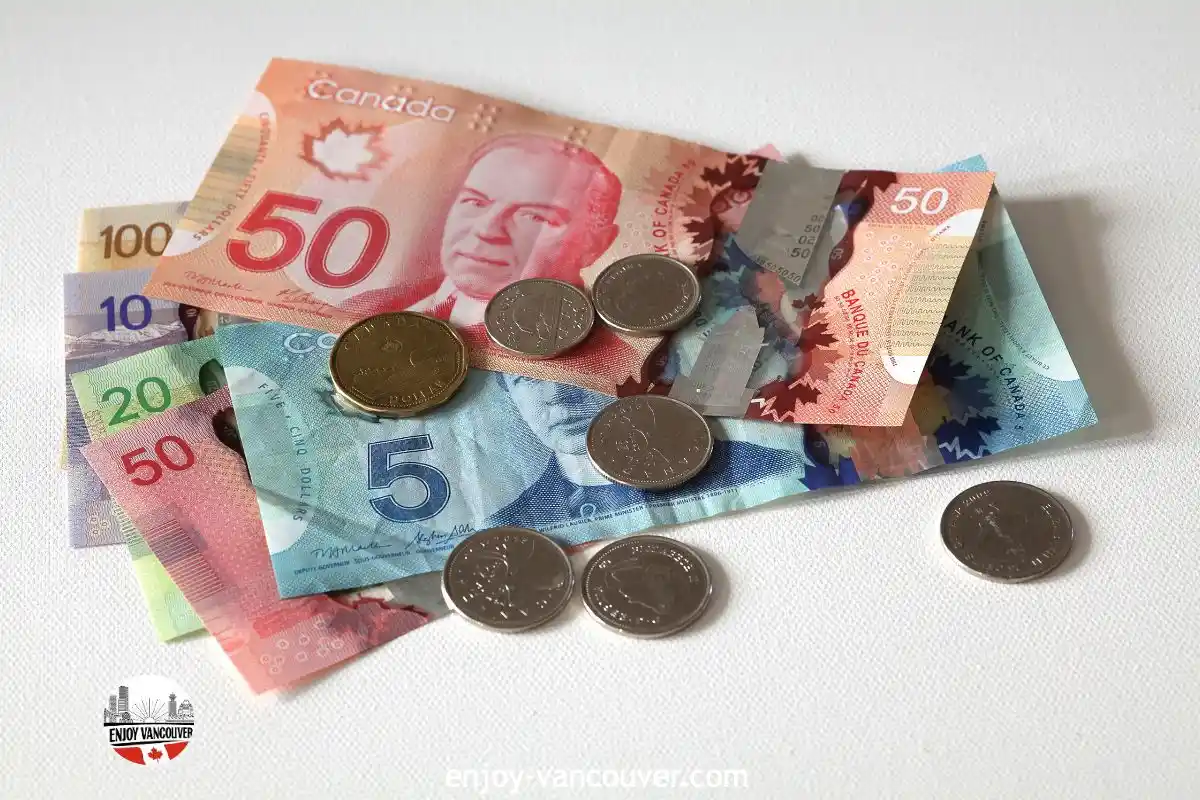
Canadian banknotes are made from polymer and are available in several colours and denominations. Familiarizing yourself with local money can make everyday cash payments easier.
| Currency Type | Common Denominations |
|---|---|
| Banknotes | $5, $10, $20, $50 and $100 |
| Coins | 5 cents, 10 cents, 25 cents, $1 and $2 |
| Loonie | Informal name for the $1 coin |
| Toonie | Informal name for the $2 coin |
Canada no longer distributes one-cent coins, commonly called pennies. Cash transactions are generally rounded to the nearest five cents after taxes, while electronic payments can still be processed to the exact cent.
For example, a final cash purchase of $10.02 may be rounded to $10.00, while $10.03 may be rounded to $10.05.
Smaller banknotes are often more convenient than carrying large denominations. Some businesses may not accept $50 or $100 bills because of their payment policies or limited change.
Can You Use U.S. Dollars in Vancouver?
Some businesses in Vancouver, particularly those serving international tourists, may accept U.S. dollar banknotes. However, accepting U.S. currency is generally a business decision rather than a standard requirement.
Even when a store or restaurant accepts U.S. dollars, its exchange rate may differ from the rate offered by a bank or currency exchange provider. You may also receive your change in Canadian dollars.
For example, a business may apply its own conversion rate when you pay for a C$30 purchase with U.S. cash.
Because exchange rates and acceptance policies vary, relying exclusively on U.S. cash can make budgeting less predictable.
Recommendation: Use Canadian dollars or an internationally accepted payment card for most purchases, and treat U.S. cash as a secondary backup rather than your main payment method.
Is It Better to Use Cash or Cards in Vancouver?
For most international visitors, using a payment card for everyday purchases and keeping a modest amount of Canadian cash provides a practical balance between convenience and flexibility.
However, the cheapest payment method depends on your card issuer, currency conversion costs, ATM fees, and the exchange rate available to you.
| Payment Method | Advantages | Potential Drawbacks | Best For |
|---|---|---|---|
| Canadian cash | No card transaction fees and easy backup payment | Risk of loss, exchange costs and possible leftover currency | Small purchases and emergencies |
| Credit card | Convenient, widely accepted and useful for reservations | Foreign transaction fees, possible interest and card surcharges | Hotels, attractions, restaurants and major purchases |
| Debit card | Direct access to available account funds | International acceptance and withdrawal fees vary | Everyday purchases and ATM withdrawals |
| Multicurrency travel card | May offer competitive conversion costs and spending controls | Loading, conversion and withdrawal fees may apply | International travel and budget management |
| Mobile wallet | Fast and convenient contactless payments | Depends on device access, card compatibility and merchant acceptance | Shopping, cafés and public transportation |
When Should You Use Cash?
Carrying some cash can be useful at markets, small independent businesses, cash-only vendors, or in situations where electronic payments are temporarily unavailable.
Cash also gives you an alternative if your bank blocks a transaction or you lose access to your phone.
When Should You Use a Credit Card?
A credit card is often convenient for hotel reservations, car rentals, attraction tickets, online bookings, and restaurant payments.
Depending on your card agreement and the laws that apply to your account, you may also benefit from purchase protection or travel-related benefits.
Before travelling, check whether your card includes foreign transaction fees and whether you can repay the balance without incurring interest.
How Much Cash Should You Carry in Vancouver?
Vancouver’s widespread acceptance of electronic payments means most tourists do not need to carry large amounts of cash.
For a typical downtown sightseeing trip, C$50–C$100 per adult is a reasonable starting point when you also have access to reliable payment cards.
Travellers visiting smaller communities, outdoor markets, or locations with limited payment options may prefer to carry a larger backup amount.
| Travel Situation | Suggested Cash to Carry |
|---|---|
| One-day city visit | C$30–C$50 |
| Three- to five-day Vancouver trip | C$50–C$100 |
| One-week trip with regional excursions | C$100–C$200 |
| Family with additional cash expenses | Adjust according to family size and planned activities |
These amounts refer to suggested backup cash, not your total travel budget. Accommodation, meals, transportation, and attraction tickets will require additional available funds.
Avoid keeping all your cash and payment cards in one wallet. Store a backup card and emergency funds separately in a secure location.
Where to Exchange Currency in Vancouver
International travellers have several options for obtaining Canadian dollars before or after arriving in Vancouver.
Exchange rates and fees vary between providers, so there is no single location that consistently offers the best deal for every currency.
1. Currency Exchange Offices in Downtown Vancouver
Downtown Vancouver has specialist foreign exchange services, including businesses in major shopping and commercial areas.
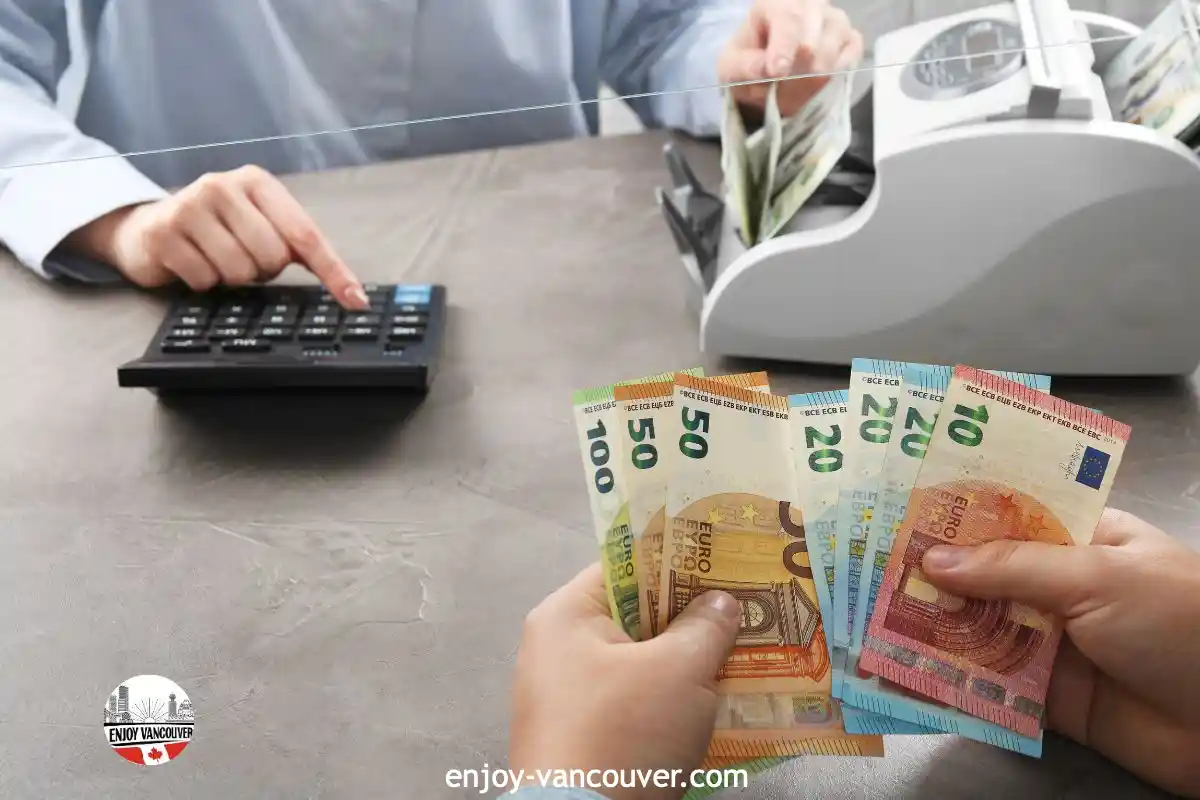
These providers may offer competitive rates for commonly traded currencies, such as U.S. dollars, euros, and British pounds.
Before exchanging money, ask how many Canadian dollars you will receive after all fees and commissions have been deducted.
Less commonly traded currencies may not be available at every location. Contact the provider before visiting if you need to exchange a specific currency.
2. Canadian Banks
Some Canadian bank branches provide foreign currency exchange services. Availability depends on the institution, branch, currency, and whether you are an existing customer.
Not every bank exchanges foreign cash for visitors without a local account. Some transactions may also require identification or advance arrangements.
Check the branch’s exchange policy before making a special trip.
3. Vancouver International Airport (YVR)
Airport currency exchange services can be convenient if you need Canadian dollars immediately after arrival.
However, convenience does not always translate into a competitive exchange rate. Compare the rate and fees with other available options whenever possible.
If you need only enough cash for your first few hours in Vancouver, consider exchanging a small amount and comparing other providers later.
Vancouver International Airport is located in Richmond rather than the City of Vancouver. You can reach downtown Vancouver by taking the Canada Line.
Check the official YVR website for current airport services and transportation information.
4. Exchange Money Before Leaving Home
Obtaining a small amount of Canadian currency before travelling can reduce stress on arrival.
Whether this is cheaper than exchanging money in Vancouver depends on the rates and fees offered by providers in your home country.
Compare the total amount you will receive instead of looking only at the advertised exchange rate or commission.
How to Find the Best Currency Exchange Rate
The exchange rate you see online is not necessarily the rate you will receive when buying Canadian cash or paying with a foreign card.
Currency providers may apply a conversion markup, transaction fee, commission, or a combination of these charges.
The Bank of Canada Currency Converter provides indicative exchange rates that are useful as a reference when comparing offers.
These indicative rates are not guaranteed retail rates and do not include the fees charged by individual currency exchange providers or card issuers.
Why “No Commission” Does Not Always Mean Cheaper
A currency exchange service can advertise zero commission while applying a less favourable exchange rate.
To compare two offers accurately, calculate how much Canadian currency you will receive for the same amount of foreign money.
| Hypothetical Example | Provider A | Provider B |
|---|---|---|
| Amount exchanged | US$500 | US$500 |
| Example exchange rate | 1.35 CAD per USD | 1.38 CAD per USD |
| Amount before fees | C$675 | C$690 |
| Additional commission | C$0 | C$5 |
| Final amount received | C$675 | C$685 |
In this example, Provider B delivers C$10 more despite charging a commission.
The rates above are hypothetical examples for explaining exchange costs. They are not current USD-to-CAD exchange rates or actual provider quotations.
Using ATMs in Vancouver
Automated teller machines (ATMs) are widely available throughout Vancouver, including at bank branches, shopping centres, convenience stores, and transportation facilities.
International debit cards may work at compatible Canadian ATMs through networks such as Plus or Cirrus.
Check the network logo on your card and confirm international withdrawal access with your card issuer before travelling.
What ATM Fees Should You Expect?
Withdrawing Canadian cash with a foreign card may involve several separate costs:
- A convenience fee charged by the Canadian ATM operator.
- An international withdrawal fee charged by your home bank.
- A foreign currency conversion markup or transaction fee.
- An additional conversion cost if you accept dynamic currency conversion.
These fees depend on your account agreement and the ATM you choose.
An ATM may display its own fee before you confirm the transaction, but it may not display all charges that your home bank will apply later.
Learn more about how ATM fees work through the Financial Consumer Agency of Canada.
How to Reduce ATM Costs
- Check your bank’s international withdrawal charges before departure.
- Look for ATMs operated by established financial institutions.
- Compare the displayed ATM fee before confirming.
- Avoid frequent small withdrawals when fixed fees apply.
- Decline an unfavourable ATM currency conversion offer.
- Withdraw only as much cash as you can reasonably use and carry safely.
Bank-operated ATMs are generally a practical starting point, but they are not automatically fee-free or cheaper than every independent ATM.
Should You Withdraw Cash Using a Credit Card?
Using a credit card to withdraw cash may be treated as a cash advance. Depending on your card’s terms, cash advances can involve transaction fees and interest that starts immediately.
A compatible debit card is often a more practical option for obtaining backup cash unless your credit card specifically offers favourable 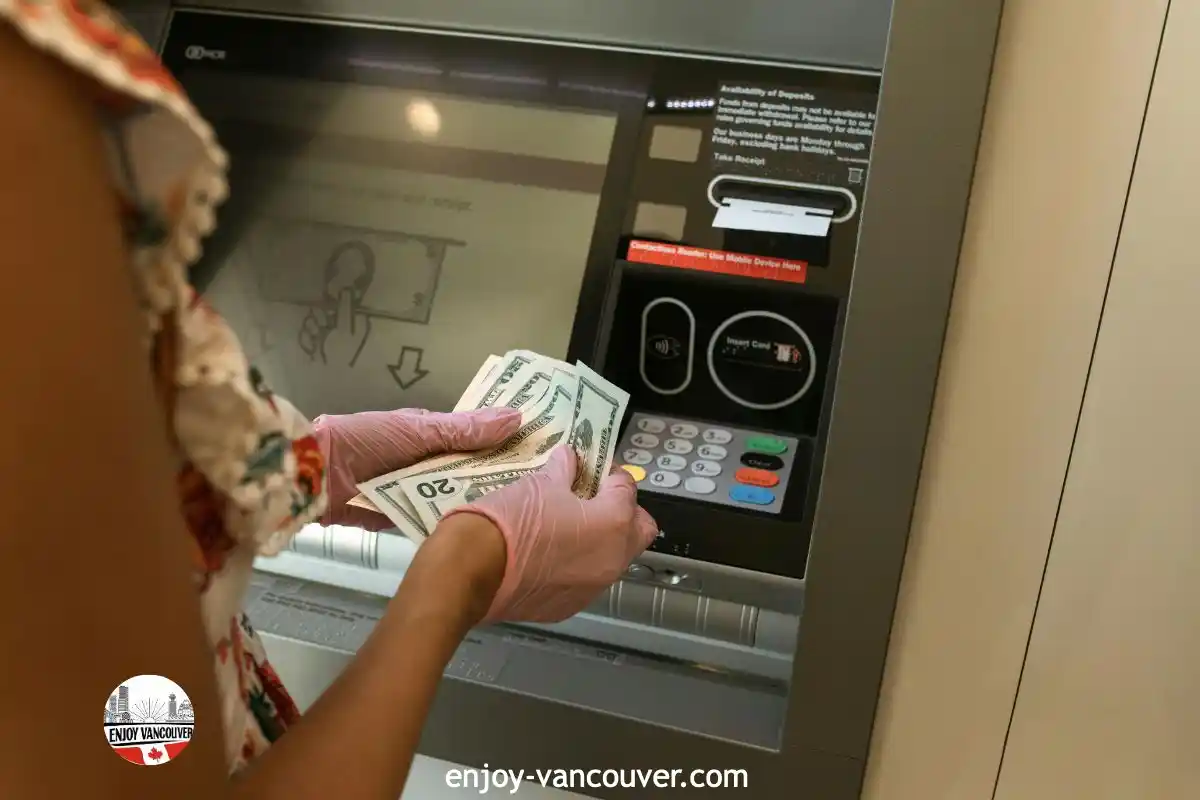
Should You Pay in Canadian Dollars or Your Home Currency?
When using an international credit or debit card in Vancouver, you may occasionally be asked whether you want to pay in Canadian dollars or in your home currency.
This service is known as Dynamic Currency Conversion (DCC).
DCC converts the transaction at the point of payment, using a rate determined by the merchant’s or ATM’s conversion provider.
Although seeing the total in your home currency may feel convenient, the offered rate may include an additional markup.
Which Currency Should You Choose?
For many travellers, choosing CAD and allowing their own card issuer or payment network to handle the conversion is the more economical option.
However, the final cost still depends on your card’s foreign transaction fees and the conversion offer displayed on the terminal.
Before accepting a conversion, review the exchange rate, total amount, and any disclosed charges.
When in doubt, paying in the local currency is a sensible default, especially if you have a card with low foreign transaction costs.
For additional information, read Visa’s international travel payment guidance.
Understanding Foreign Transaction Fees
Some credit and debit cards charge a percentage-based fee when you make a purchase in a currency different from your account currency.
Other cards offer reduced or zero foreign transaction fees, although their exchange rates and other account costs may vary.
For example, if your card charges a 2.5% foreign transaction fee, purchases equivalent to C$1,000 would generate approximately C$25 in additional conversion-related charges.
This example illustrates a hypothetical fee. Your actual statement amount will depend on the applicable exchange rate, billing currency, and card agreement.
What to Check Before Travelling to Vancouver
- Your card’s foreign transaction and currency conversion fees.
- International ATM withdrawal charges and daily limits.
- Whether your card supports contactless payments in Canada.
- Whether your bank requires a travel notification.
- How to contact your card issuer from another country.
- Whether your card provides sufficient available credit for deposits and reservations.
Bringing two compatible cards from different issuers can provide additional flexibility if one is declined, lost, or temporarily blocked.
How to Pay for Public Transportation in Vancouver
Visitors can travel around Metro Vancouver using buses, SkyTrain, SeaBus, and other TransLink services.
You do not necessarily need Canadian cash or a local bank account to use public transportation.
Contactless Card Payments
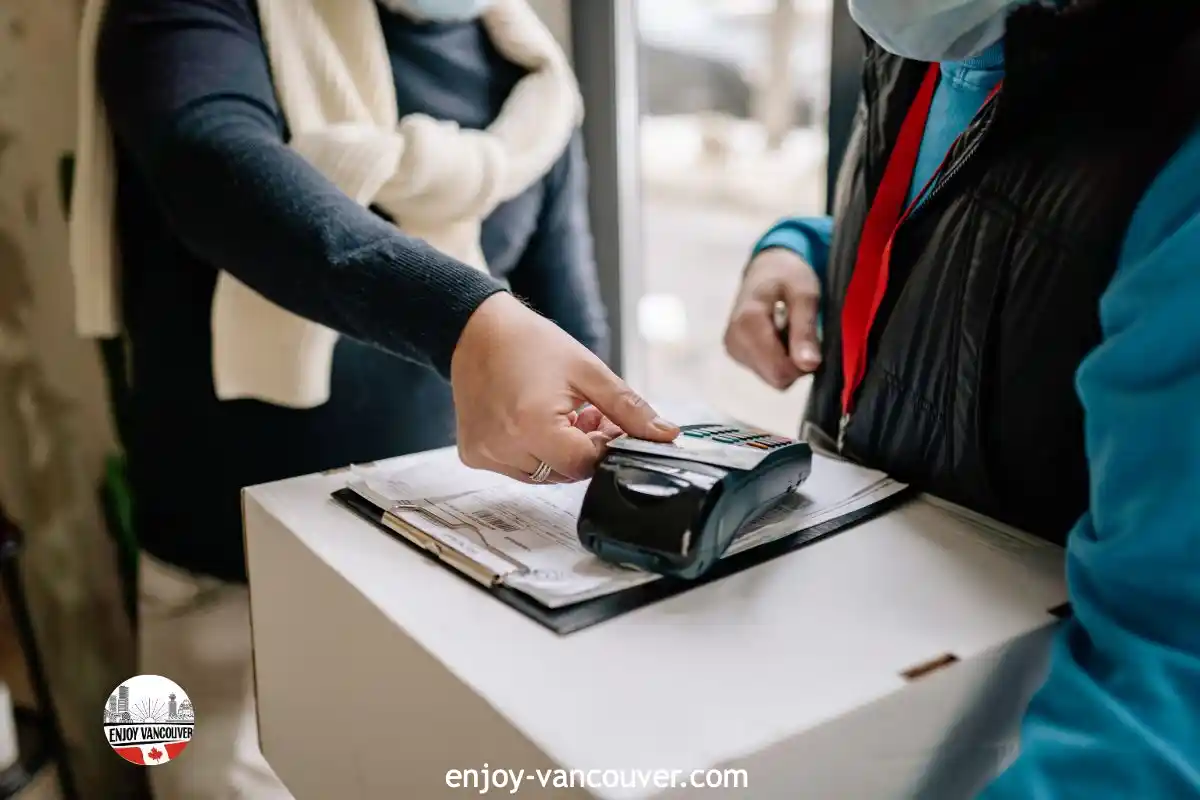
TransLink accepts eligible contactless credit and debit cards, along with compatible mobile wallets, for adult cash fares.
Use the same physical card or mobile wallet when tapping in and out of fare-controlled SkyTrain and SeaBus stations. On buses, tap when you board.
Each paying passenger needs their own payment method or valid transit fare.
Compass Cards and Tickets
Visitors who expect to use transit frequently may benefit from comparing the cost of a reloadable Compass Card, stored value, and a DayPass.
A Compass Card currently requires a C$6 refundable deposit.
Cash can be used directly on buses, where exact fare is required. A cash fare paid on a bus cannot be used to enter SkyTrain or SeaBus fare gates; if you need to transfer between modes, choose a compatible payment method or ticket.
For current fares, fare zones, airport-related charges, and payment options, consult the TransLink visitor guide.
Hotel Payments and Credit Card Deposits
Many hotels in Vancouver accept major credit cards for room payments and incidental expense deposits.
Even when you have prepaid your accommodation, the hotel may require a valid payment card at check-in to cover potential additional costs.
This may involve a temporary authorization that reduces your available credit until the hotel and your card issuer release it.
Debit cards, prepaid travel cards, and cash deposits may not be accepted for every reservation.
Before booking accommodation, ask the hotel about:
- Accepted payment methods.
- Required deposits or card authorizations.
- Whether the cardholder must be present at check-in.
- Estimated authorization release times.
- Taxes, mandatory fees, parking charges and cancellation conditions.
Similar considerations apply when renting a car. Some rental companies have stricter requirements for debit cards, prepaid cards, and cash payments.
Understanding Sales Taxes in Vancouver
International visitors may be surprised when the amount displayed at checkout is higher than the price shown on a menu, shelf label, or hotel booking page.
In Canada, advertised prices often exclude applicable sales taxes. The final amount depends on what you purchase and which tax rules apply.
GST and PST in British Columbia
The federal Goods and Services Tax (GST) is generally 5%.
British Columbia’s general Provincial Sales Tax (PST) rate is 7%. However, certain goods and services are exempt or subject to different rates.
| Purchase Type | Typical Tax Treatment |
|---|---|
| Clothing, electronics and most taxable souvenirs | 5% GST + 7% PST |
| Restaurant meals, excluding separately taxable beverages and items | Generally 5% GST; food is exempt from PST |
| Qualifying basic groceries | Generally zero-rated for GST and exempt from PST |
| Alcoholic beverages | Generally 5% GST + 10% PST |
| Taxable short-term accommodation in Vancouver | Special accommodation taxes and GST apply |
Individual products and services may have different tax treatment. Check the Government of British Columbia’s sales tax guidance for more information.
How Much Tax Is Added to Vancouver Hotel Rooms?
Taxable short-term accommodation within the City of Vancouver is currently subject to several taxes, including:
- 8% Provincial Sales Tax (PST) on accommodation.
- 3% Municipal and Regional District Tax (MRDT).
- 2.5% additional Major Events MRDT, currently scheduled to apply through January 31, 2030.
- 5% federal GST applied to the accommodation price and the applicable provincial accommodation taxes during this period.
For example, a taxable hotel room priced at C$200 before taxes would have the following estimated breakdown:
| Hotel Cost Example | Amount |
|---|---|
| Room price | C$200.00 |
| PST (8%) | C$16.00 |
| MRDT (3%) | C$6.00 |
| Major Events MRDT (2.5%) | C$5.00 |
| GST (5% of C$227) | C$11.35 |
| Estimated total | C$238.35 |
This example assumes a fully taxable accommodation purchase within the City of Vancouver and excludes any additional hotel charges.
Accommodation tax rates may differ in Richmond, Burnaby, North Vancouver, and other municipalities.
For the applicable rules, see the B.C. government notice for Vancouver accommodation providers.
How Much Should You Tip in Vancouver?
Tipping is customary in Vancouver, particularly at restaurants with table service. However, voluntary tips are not generally a legal requirement.
The amount you choose to tip depends on the service provided, the circumstances, and your personal preference.
| Service | Suggested Tipping Practice |
|---|---|
| Full-service restaurant | Around 15–18% of the pre-tax bill |
| Cafés and takeaway counters | Optional |
| Taxi or rideshare | Optional; 10–15% is a possible guideline |
| Hotel housekeeping | Optional; a few dollars per day if desired |
| Tour guides | Optional, depending on the tour and service |
These are suggested practices rather than fixed charges or official tipping requirements.
Restaurant Bill Example
For a C$50 restaurant meal containing only items subject to GST and exempt from PST, your bill might look like this:
| Expense | Amount |
|---|---|
| Meal subtotal | C$50.00 |
| GST (5%) | C$2.50 |
| Voluntary tip (15% of subtotal) | C$7.50 |
| Total payment | C$60.00 |
Some payment terminals calculate suggested tips using the after-tax total. You can choose a custom amount if you prefer to calculate your tip before tax.
Restaurants may also include a mandatory gratuity or service charge, especially for larger groups. Review your bill before adding an extra tip.
The Destination Vancouver travel guide provides additional information about local payment and tipping customs.
How Much Travel Money Do You Need per Day in Vancouver?
Daily spending in Vancouver depends on your travel style, accommodation arrangements, dining preferences, transportation choices, and planned activities.
The following table provides illustrative planning allowances per adult, excluding accommodation, flights, major shopping, and exceptional expenses.
| Daily Expense | Budget Travel | Mid-Range Travel | Higher-Spending Travel |
|---|---|---|---|
| Meals and drinks | C$30–$45 | C$50–$85 | C$100–$160 |
| Local transportation | C$8–$15 | C$10–$25 | C$30–$70 |
| Activities and attractions | C$0–$20 | C$25–$60 | C$75–$150 |
| Miscellaneous expenses | C$5–$15 | C$15–$30 | C$30–$60 |
| Estimated daily allowance | C$43–$95 | C$100–$200 | C$235–$440 |
These figures are author-created budgeting scenarios, not surveyed average prices or guaranteed travel costs. Allow for applicable taxes and tips when estimating individual expenses.
Visitors can reduce their spending by combining paid attractions with free outdoor activities, waterfront walks, parks, and public spaces.
If you are planning paid sightseeing activities, our Vancouver Lookout guide explains admission costs, visiting times, and considerations before purchasing tickets.
Travelling during the colder months? Read our Vancouver in Winter guide for seasonal travel planning and activity ideas.
How Much Money Can You Bring into Canada?
Canada does not impose a general maximum amount of money that travellers can legally carry into or out of the country.
However, if you are carrying currency or monetary instruments with a combined value of C$10,000 or more, you must declare them to the Canada Border Services Agency (CBSA).
The declaration requirement covers the combined Canadian-dollar equivalent of Canadian currency, foreign currency, and applicable monetary instruments such as certain cheques, bank drafts, and money orders.
The rule applies when entering or leaving Canada.
Declaring money does not automatically mean you must pay a tax or fee simply for carrying it. However, failure to declare when required can result in penalties or seizure.
For current reporting requirements and instructions, read the official CBSA currency declaration guide.
10 Travel Money Tips for Visiting Vancouver
- Use Canadian dollars rather than relying on U.S. or other foreign cash.
- Carry a small amount of Canadian cash as a backup.
- Check international card fees before leaving home.
- Compare currency exchange offers using the final amount received.
- Choose CAD at payment terminals unless another option offers a demonstrably better total cost.
- Review ATM charges before confirming withdrawals.
- Keep a backup payment card separate from your main wallet.
- Include sales taxes and discretionary tips when preparing your travel budget.
- Confirm hotel and rental car deposit requirements in advance.
- Monitor your transactions and report unfamiliar charges promptly.
Frequently Asked Questions About Travel Money in Vancouver
What currency does Vancouver use?
Vancouver uses the Canadian dollar (CAD). Prices are generally displayed in Canadian dollars unless another currency is clearly indicated.
Is it better to use cash or a credit card in Vancouver?
For most tourists, a credit or debit card with competitive foreign transaction terms is convenient for everyday purchases. Carrying a small amount of Canadian cash provides a useful backup.
Can I use U.S. dollars in Vancouver?
Some businesses accept U.S. dollars, but acceptance is not guaranteed. Merchants may use their own exchange rates and provide change in Canadian currency.
Is Vancouver a cashless city?
No. Electronic payments are widely available, but many businesses also accept cash. Payment policies vary by merchant.
How much Canadian cash should I bring to Vancouver?
C$50–C$100 per adult is a reasonable suggested backup for a typical multi-day city trip if you also have reliable payment cards. This amount is not intended to cover your entire travel budget.
Where is the best place to exchange currency in Vancouver?
There is no universally cheapest location. Compare specialist currency exchange offices, banks, airport services, and providers in your home country based on the final amount of Canadian currency you will receive.
Is it better to exchange money before travelling to Canada?
Exchanging a small amount before departure can be convenient. Whether it is cheaper depends on the exchange rates and fees available in your home country compared with those in Vancouver.
Can I use my foreign debit card in Vancouver?
Many international debit cards work at compatible payment terminals and ATMs. Check your card’s network, international payment settings, withdrawal limits, and fees before travelling.
Can I use Apple Pay or Google Pay in Vancouver?
Yes, compatible mobile wallets are widely accepted at participating contactless payment terminals. Keep a physical payment card or cash available in case your device or mobile wallet is unavailable.
Should I choose CAD when paying with an international card?
Choosing CAD is generally a sensible default because it avoids merchant-provided dynamic currency conversion. The final cost still depends on your card issuer’s terms and exchange rate.
Do I need cash for Vancouver public transportation?
No. TransLink accepts eligible contactless payment cards, mobile wallets, Compass Cards, and Compass Tickets. Cash is also accepted directly on buses, subject to fare rules.
Are taxes included in Vancouver prices?
Sales taxes are often added at checkout. The applicable taxes depend on the type of purchase, with different rules for retail goods, restaurant meals, accommodation, and exempt products.
Is tipping mandatory in Vancouver?
Voluntary tipping is customary but not generally mandatory. Some businesses may include a mandatory gratuity or disclosed service charge, so review your bill before adding a tip.
How much money can I bring into Canada without declaring it?
The currency reporting requirement applies when the combined value of cash and applicable monetary instruments reaches C$10,000 or more. This includes foreign currency converted to its Canadian-dollar equivalent.
Final Thoughts: The Best Way to Manage Your Travel Money in Vancouver
Vancouver is a convenient destination for travellers who prefer card payments, but having more than one way to pay is always useful.
For most international visitors, the practical approach is to use a low-cost payment card for everyday purchases, carry a modest amount of Canadian cash, and compare exchange offers before converting larger amounts.
Remember to include sales taxes, restaurant tips, accommodation deposits, and possible banking fees when calculating your total travel budget.
With a little preparation, you can spend less time worrying about payment methods and more time exploring Vancouver’s neighbourhoods, attractions, waterfront, and surrounding landscapes.
Planning your Vancouver trip? Explore more local travel guides and attraction recommendations on Enjoy Vancouver.
Information reviewed in November 2026. Exchange rates, banking fees, merchant policies, transportation fares and tax rules may change. Confirm current conditions with the relevant official provider before travelling.